 Pocket Gate
Listen
An active and passive sweep of channels 1–14. Every network found contributes its BSSID, its signal strength, and the channel it sits on.
Pocket Gate sweeps the 2.4 GHz band, weighs the ether by channel, and casts a Rider‑Waite card from the noise. No app. No account. Nothing about you ever leaves the device.
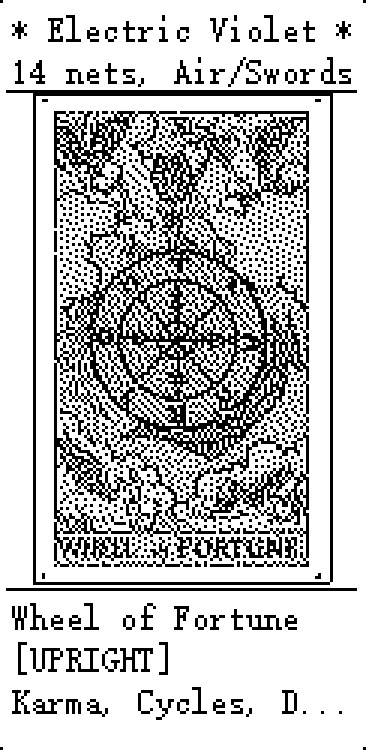
Real firmware output — rendered byte-for-byte from the device sources, not a mock-up.
There is no shuffle button and no random seed you control. The device listens to the ambient spectrum, hashes what it hears, and that hash picks the card. Move to a different room and the answer changes — because the air changed.
An active and passive sweep of channels 1–14. Every network found contributes its BSSID, its signal strength, and the channel it sits on.
Networks are counted into channel clusters. The loudest cluster names the elemental domain; the sheer count names the aura.
Each BSSID and RSSI is mixed into an FNV‑1a hash. The hash modulo 22 is your card, and the next bits of it decide whether the card falls reversed — one time in four.
The reading lands on one of nine gates: five thresholds of density, four domains of element. The gate you pass is the gate you are standing in.
The first five gates are thresholds — how much is moving. The last four are domains — where in the band the movement is concentrated. Every reading crosses one of each.
0 networks
Nothing on the band. The aura reads Void Obsidian and the Hermit comes forward.
1–3 networks
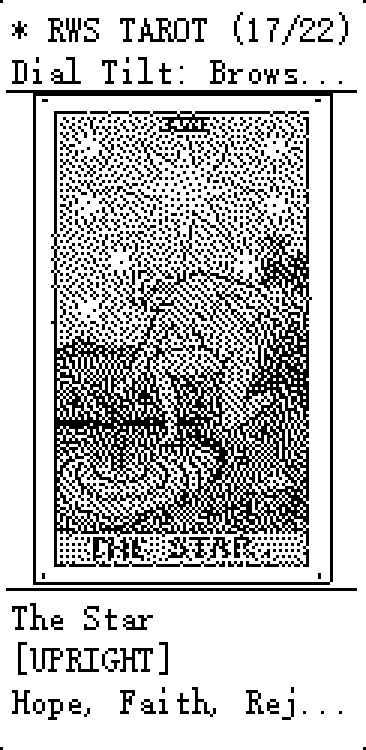
Sparse and calm. Astral Lavender, and the Star keeps the watch.
4–8 networks
Enough signal to work with. Solar Amber, and the Magician takes the deck.
9–15 networks
The band is busy and moving. Electric Violet, and the Wheel starts to turn.
16 or more networks
Dense ether. Hyper Cobalt, and the Tower does what the Tower does.
busiest of channels 1–4
Low-band congestion. The suit is Discs: bodies, work, the ground under your feet.
busiest of channels 5–8
Mid-band congestion. The suit is Wands: motion, will, the thing already set alight.
busiest of channels 9–12
Upper-mid congestion. The suit is Cups: feeling, memory, the undertow.
15+ networks, or the sparsest cluster wins
The ninth gate. Taken outright at fifteen networks and above, and otherwise the last word. The suit is Swords: thought, edge, the mind cutting clear.
This runs the device’s actual casting rules in your browser against a simulated radio environment. It is not a scan — your browser cannot hear 2.4 GHz — but the mapping from air to card is the same one the hardware uses.
On the device the same code path runs against a real sweep: BSSIDs and RSSI values in, a card and an aura out.
—
—
—
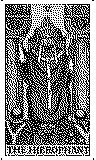
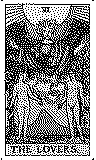
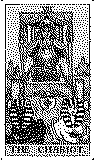
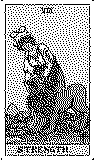
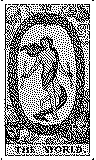
The 1909 Rider–Waite–Smith deck, by Pamela Colman Smith, is in the public domain. Each plate is reduced to pure black and white at 96 × 160 pixels — the real size the panel draws them — so the artwork survives the dither instead of smearing.
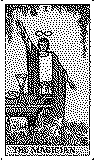
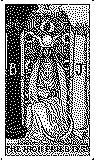
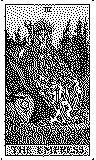
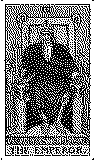
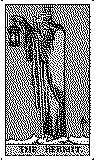
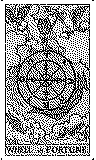
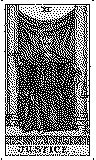
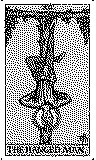
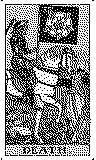
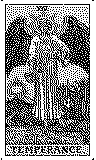
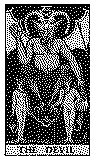
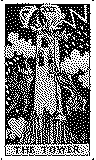
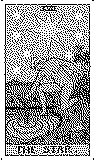
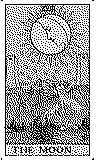
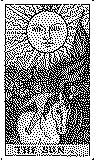
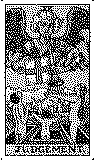
No radio module, no display driver, no battery management. The CrowPanel ESP32‑S3 2.13″ already carries the ESP32‑S3, the panel, the dial and the USB.
| MCU | ESP32‑S3, 240 MHz, 8 MB PSRAM |
|---|---|
| Display | 2.13″ B/W e-paper, 122 × 250 px, SSD1680, 1 bit |
| Radio | 2.4 GHz 802.11 b/g/n, station mode, active + passive scan |
| Controls | 5‑way dial (push, tilt left, tilt right), HOME, EXIT |
| Deck | 22 major arcana, 96 × 160 px bitmaps in flash |
| Build | PlatformIO, Arduino framework, MIT licence |
| Screen power | GPIO 7 |
|---|---|
| SPI |
SCK 12 · MOSI 11 · CS
14 · DC 13 · RST
10 · BUSY 9
|
| Dial |
HOME 2 · EXIT 1 · LEFT
6 · RIGHT 4 · PUSH
5
|
| LED | GPIO 19 |
No app, no account, no cloud. The Wi-Fi radio is used only as a receiver: the device sweeps the band and hashes what it hears. It never associates with a network, never authenticates, and never opens a socket.
It is arbitrary, but it is not independent of where you are. The card index comes from a hash of the BSSIDs and signal strengths around you, so the same room tends to give the same answer until the air changes — a neighbour starts a new access point, a microwave runs, you carry it to the next floor. Standing still and casting again gives you the same card. That is the point.
Because the panel is 122 × 250 and the artwork needs to be legible. The major arcana is the part of the deck that survives being reduced to one bit at that size; the minor arcana is next, once the art pipeline handles pip cards.
E-paper only draws power when the picture changes, and the panel is put back to sleep after every refresh. Expect weeks of casual use rather than days.
Nothing leaves the device. There is no telemetry, no analytics and no server. The only thing this website stores is an email address, and only if you type it into the waitlist form.
Pamela Colman Smith, in 1909. Her plates for the Rider–Waite deck have been in the public domain for decades and are used here without permission or credit, which is a debt the tarot world owes her.
Leave an address and we will write once, when there is something to write about. No newsletter, no drip campaign.